
Elizabeth Bishop Biography
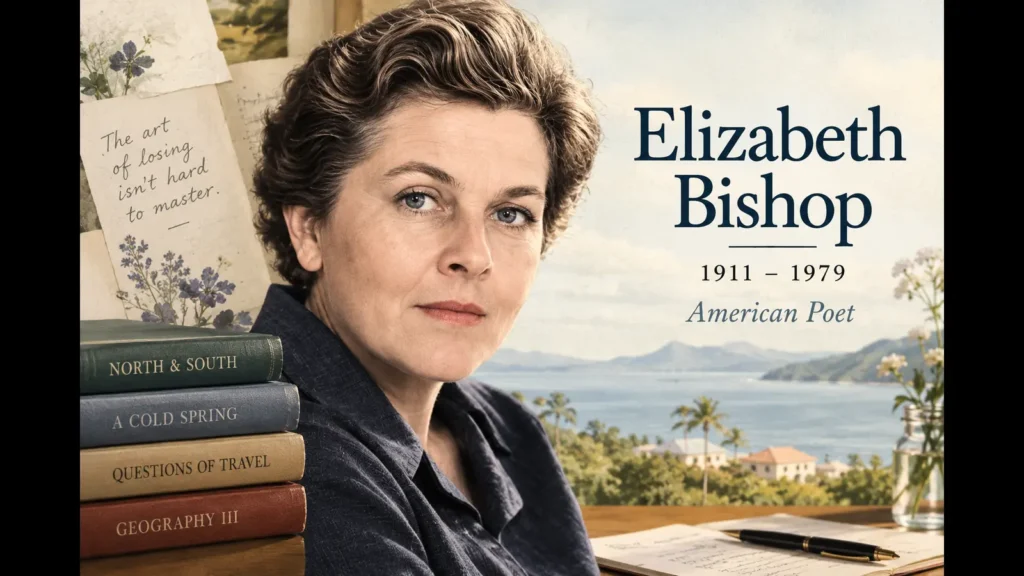
Quick Facts
- Born
- February 8, 1911
- Died
- October 6, 1979
- Movement
- Modernism / Modern American Poetry
- Famous Quote
- “The art of losing isn’t hard to master.” __One Art“All the untidy activity continues, awful but cheerful.” __The Bight
- Known For
- Precise imagery, detailed observations of nature and everyday life, emotional restraint, and poems exploring loss, memory, travel, and belonging. Her famous poems include The Fish, One Art, and In the Waiting Room.
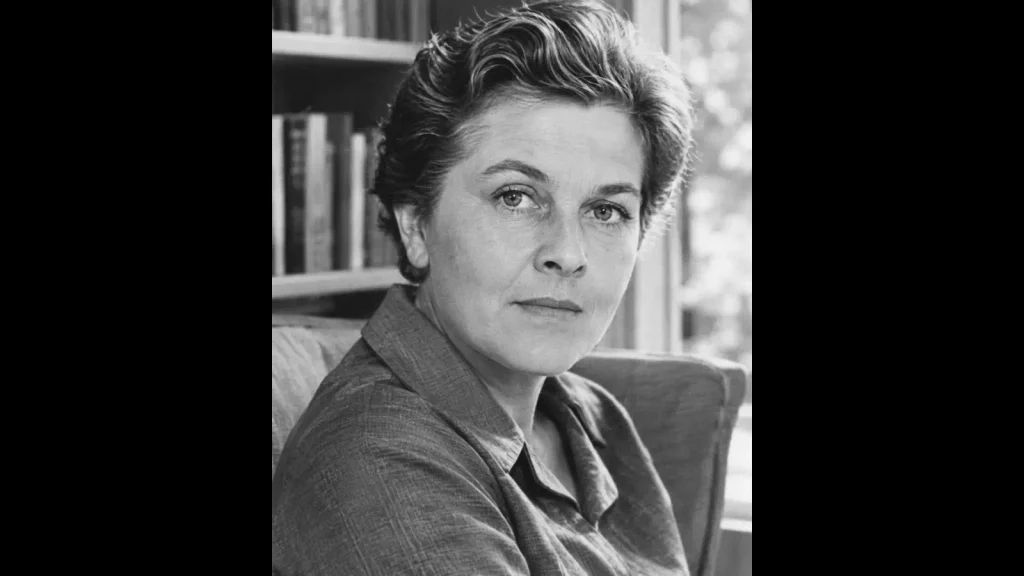
Elizabeth Bishop Biography: Life, Poems, and Literary Legacy
Elizabeth Bishop (1911–1979) was an American poet known for her precise descriptions, carefully shaped poems, and quiet exploration of loss, memory, and belonging. Born on February 8, 1911, in Worcester, Massachusetts, she became one of the most respected poets of the twentieth century. Her best-known works include The Fish, One Art, Sestina, and In the Waiting Room. She won the Pulitzer Prize for Poetry in 1956 and the National Book Award in 1970.
The Elizabeth Bishop biography is also a story of travel, family hardship, friendship, and a lifelong search for home. She lived in several parts of the United States and spent many years in Brazil. These experiences gave her poetry a wide range of settings, from cold northern landscapes to tropical scenes. Instead of openly explaining her feelings, Bishop often used ordinary objects, animals, and places to reveal deeper emotions. Her careful style continues to interest students, teachers, and poetry lovers around the world.
Elizabeth Bishop Quick Facts
| Detail | Information |
|---|---|
| Full name | Elizabeth Bishop |
| Born | February 8, 1911 |
| Died | October 6, 1979 |
| Birthplace | Worcester, Massachusetts, United States |
| Nationality | American |
| Occupation | Poet, short-story writer, translator, and teacher |
| Education | Vassar College, graduated in 1934 |
| Famous poems | The Fish, One Art, Sestina, The Moose, In the Waiting Room |
| Major poetry collections | North & South, A Cold Spring, Questions of Travel, Geography III |
| Literary period | Twentieth-century American poetry; associated with modern poetry |
| Major awards | Pulitzer Prize for Poetry, National Book Award, National Book Critics Circle Award |
| Teaching career | Harvard University, 1970–1977 |
These facts are supported by the Academy of American Poets and the Library of Congress.
Where Was Elizabeth Bishop Born, and What Was Her Childhood Like?
Elizabeth Bishop was born in Worcester, Massachusetts, on February 8, 1911, but spent much of her childhood moving between family homes. Her father died when she was an infant, and her mother was later placed in a mental health institution. These early losses deeply affected her life.
Bishop first lived with her maternal grandparents in Nova Scotia, Canada. Later, she moved to Massachusetts to live with relatives on her father’s side of the family. These changes gave her an early experience of separation and uncertainty. The places where she lived would later become important parts of her poetry.
Her childhood helps explain why home, memory, and belonging appear so often in her work. However, Bishop rarely described her private pain in a direct way. Instead, she created scenes involving children, family members, houses, and landscapes that allow readers to discover the emotions beneath the surface.
How Did Elizabeth Bishop Begin Her Writing Career?
Elizabeth Bishop developed her writing skills at Vassar College, where she graduated in 1934 and became involved in literary activities. There, she met Marianne Moore, an established American poet who became her friend and mentor. Moore encouraged Bishop’s careful approach to language and poetic form.
After college, Bishop traveled through Europe and North Africa before settling in Key West, Florida. The places she visited helped shape her interest in landscapes, different cultures, and the details of everyday life. Her first major poetry collection, North & South, appeared in 1946.
Bishop did not publish as many poems as some of her contemporaries. She revised her work carefully and often spent long periods improving individual poems. This patient process helped her create poetry that feels clear and natural while containing complex ideas.
What Was Elizabeth Bishop’s Life Like in Brazil?
Elizabeth Bishop lived in Brazil for many years after visiting the country in 1951. She developed a close relationship with Brazilian architect Lota de Macedo Soares and became deeply connected to Brazilian landscapes and daily life.
Brazil brought new subjects into Bishop’s poetry, including tropical weather, unfamiliar customs, travel, and the relationship between visitors and the places they explore. Her collection Questions of Travel reflects these interests. It considers why people leave home, what they discover elsewhere, and whether travel can truly resolve feelings of displacement.
Bishop’s relationship with Soares ended in tragedy when Soares died by suicide in 1967. This loss added to the grief Bishop had experienced throughout her life. Her later poetry, especially Geography III, shows a more direct engagement with memory and personal experience, although she continued to express emotion with restraint.
What Awards Did Elizabeth Bishop Win?
Elizabeth Bishop won several major literary awards, including the Pulitzer Prize for Poetry in 1956 and the National Book Award in 1970. These honors recognized her lasting contribution to American poetry.
Her most important awards include:
- Pulitzer Prize for Poetry (1956): Awarded for Poems: North & South—A Cold Spring.
- National Book Award (1970): Recognized The Complete Poems.
- National Book Critics Circle Award (1976): Awarded for Geography III.
- Neustadt International Prize for Literature (1976): Recognized her wider literary achievement.
Bishop also served as Consultant in Poetry to the Library of Congress from 1949 to 1950, a position now associated with the history of the U.S. Poet Laureate. She later taught at Harvard University from 1970 to 1977. Her achievements helped establish her as one of the leading American poets of her time.
What Made Elizabeth Bishop’s Writing Style Unique?
Elizabeth Bishop’s writing style is known for precise observation, vivid imagery, controlled emotion, and careful use of poetic form. She often begins with a real object or scene and gradually reveals a deeper meaning through its details.
Unlike poets who openly describe their personal feelings, Bishop often allows readers to understand emotions through what the speaker sees and remembers. A fish, a filling station, a waiting room, or a snowy landscape can become a way to explore identity, loss, and human relationships.
Her poetry also shows strong technical skill. She used forms such as the villanelle, sestina, and sonnet, which follow specific rules for repetition, rhyme, or structure. These forms helped her shape difficult emotions without making them sound overly dramatic.
Bishop’s style is especially powerful because ordinary details often carry more than one meaning. Her poems invite readers to look closely, notice small changes, and think about what remains unspoken.
What Are the Main Themes in Elizabeth Bishop’s Poetry?
Elizabeth Bishop’s poetry explores loss, travel, memory, identity, nature, and the search for belonging. These themes often appear through descriptions of ordinary scenes rather than direct statements about the poet’s life.
- Loss and grief: Poems such as One Art explore the struggle to accept the loss of people, places, and familiar things.
- Travel and displacement: Questions of Travel considers the desire to leave home and the uncertainty of finding a place where one belongs.
- Memory and childhood: Sestina and In the Waiting Room show how childhood experiences can shape a person’s understanding of the world.
- Nature and observation: The Fish and At the Fishhouses use detailed descriptions of the natural world to explore respect, knowledge, and change.
- Identity and self-understanding: Bishop often presents moments when people become aware of themselves, their history, or their place in society.
- Everyday life: Ordinary objects and familiar settings become meaningful through the close attention she gives them.
These themes connect Bishop’s personal experiences with questions that many readers recognize in their own lives.
Elizabeth Bishop Poems: Her Most Famous Works
Elizabeth Bishop published approximately 101 poems during her lifetime, although the exact count can vary depending on how unpublished and collected work is counted. Her poetry is known for careful descriptions, formal skill, and a quiet exploration of human experience.
The following Elizabeth Bishop poems are among her best-known works. They offer a useful introduction to her writing, from her observations of animals and landscapes to her reflections on loss and identity.
The Fish
Published in North & South in 1946, The Fish describes a speaker who catches a large fish and studies its battered body. The close attention given to its marks and scars gradually changes the speaker’s view of the animal. The poem is important for showing how patient observation can lead to respect and a surprising emotional response.
One Art
Published in Geography III in 1976, One Art explores the experience of losing things, relationships, and people. It uses the repeating structure of a villanelle to present loss as something that can supposedly be controlled. As the poem develops, the speaker’s confidence becomes harder to believe, revealing the pain hidden behind an attempt to remain calm.
Sestina
First published in the 1950s, Sestina presents a grandmother and a child in a house filled with quiet sadness. Its repeating words create a sense of routine while suggesting that the characters are hiding difficult feelings. The poem is a strong example of how Bishop used a demanding poetic form to express emotion indirectly.
In the Waiting Room
Published in Geography III in 1976, In the Waiting Room follows a young girl visiting a dentist’s waiting room with her aunt. While reading a magazine, she suddenly becomes aware of her identity and connection to other people. The poem turns an ordinary childhood moment into a powerful question about self-awareness and belonging.
The Moose
Published in Geography III in 1976, The Moose describes a bus journey through rural Canada before a moose appears beside the road. The journey brings together passengers, memories, conversation, and the natural world. The animal’s unexpected presence creates a shared moment of wonder and connects Bishop’s poetry to the landscapes of her childhood.
At the Fishhouses
First published in A Cold Spring in 1955, At the Fishhouses describes a cold coastal setting, including fishing buildings, water, and an elderly fisherman. Its detailed observations gradually lead to questions about knowledge, experience, and the passage of time. The poem shows Bishop’s ability to move from physical description to philosophical reflection without losing its sense of place.
Questions of Travel
The title poem of Bishop’s 1965 collection Questions of Travel examines the desire to visit unfamiliar places and experience different ways of life. It questions whether travel is necessary or whether staying home might offer its own value. The poem reflects Bishop’s experiences abroad while leaving readers to consider the complicated relationship between curiosity, escape, and belonging.
The Armadillo
Published in Questions of Travel in 1965, The Armadillo describes the effects of airborne fire balloons on animals in Brazil. The poem contrasts a festive human activity with the danger it creates for vulnerable creatures. Its vivid images reveal Bishop’s moral awareness and her ability to show the consequences of human actions without relying on a simple lecture.
What Were Elizabeth Bishop’s Major Poetry Collections?
Elizabeth Bishop’s major collections show how her poetry developed from precise descriptions of places and objects toward more personal questions about memory, identity, and loss. Her published books were relatively few, but each reflects years of careful work.
North & South (1946)
North & South was Bishop’s first major poetry collection. It includes poems shaped by her experiences in New England, Florida, and other places she visited. The collection established her interest in detailed observation, unusual images, and the emotional meanings hidden in everyday scenes.
A Cold Spring (1955)
A Cold Spring developed Bishop’s reputation for technical skill and vivid description. Its poems explore natural settings, human relationships, and moments of uncertainty. The book was published alongside North & South in the combined volume that received the 1956 Pulitzer Prize for Poetry.
Questions of Travel (1965)
Questions of Travel reflects Bishop’s years in Brazil and her interest in the experience of being a visitor in another country. Its poems explore landscapes, cultural differences, and the reasons people leave familiar surroundings. Travel becomes both a source of discovery and a way to question the meaning of home.
The Complete Poems (1969)
The Complete Poems brought together Bishop’s poetry and received the National Book Award in 1970. The collection made it easier for readers to see the connections between her earlier work and her developing interests. It also helped secure her reputation as a major twentieth-century American poet.
Geography III (1976)
Geography III was Bishop’s final major poetry collection published during her lifetime. It includes One Art, In the Waiting Room, and The Moose. The poems return to childhood, memory, and personal experience while preserving her careful descriptions and controlled style.
How Did Elizabeth Bishop Influence Modern American Poetry?
Elizabeth Bishop influenced modern American poetry by showing how precise description, formal control, and emotional restraint could create deeply moving work. Her poems demonstrate that personal experience does not always need to be explained directly to be understood.
Her approach differed from the confessional poetry associated with contemporaries such as Robert Lowell, who often wrote more openly about private struggles. Bishop instead placed much of her emotional meaning in images, settings, and carefully arranged words. This made her poetry rewarding for both close reading and repeated study.
Bishop’s work remains important in schools, universities, and literary criticism. Students can learn from her use of imagery, repetition, structure, and point of view, while general readers can connect with her treatment of change and loss. Her example continues to show how a small, accurately observed moment can reveal something large about human life.
When Did Elizabeth Bishop Die?
Elizabeth Bishop died on October 6, 1979, in Boston, Massachusetts, at the age of 68. She had returned to New England after many years of travel and residence abroad, and she spent her final years writing and teaching.
Her death came two years after the publication of Geography III, the collection that included several of her most widely studied poems. The book reflects her growing willingness to explore childhood memories and personal experience while retaining her distinctive restraint.
Bishop’s legacy rests not on the number of books she published but on the care she brought to each poem. Her work continues to be read for its exact language, rich imagery, and thoughtful treatment of ordinary life.
Conclusion: Why Elizabeth Bishop Still Matters
Elizabeth Bishop remains an important figure in American poetry because she showed how close observation can uncover the emotions hidden in ordinary life. Her poems explore loss, memory, travel, and belonging without relying on simple explanations or dramatic statements. Through works such as The Fish, One Art, and In the Waiting Room, she invites readers to notice the details that often go unseen. Her childhood experiences, years in Brazil, and friendships with other writers helped shape a body of work that is both personal and widely relatable. Although she published relatively few poems, her careful revisions and command of poetic form gave each work lasting strength. For students and poetry lovers, reading Elizabeth Bishop offers a lesson in patience, language, and the power of looking closely at the world. Her poetry continues to reward readers who return to it with fresh attention.
Frequently Asked Questions About Elizabeth Bishop
Elizabeth Bishop was an American poet and short-story writer born in 1911. She became known for precise imagery, carefully controlled emotion, and poems about nature, travel, memory, and loss. She won the Pulitzer Prize for Poetry in 1956 and the National Book Award in 1970.
One Art and The Fish are two of Elizabeth Bishop’s best-known poems. One Art explores the pain of losing people and things, while The Fish shows how careful observation can lead to respect and a change in perspective.
One poetry resource records approximately 101 poems published during Bishop’s lifetime. The exact total depends on whether drafts, unpublished work, and poems collected after her death are included.
Elizabeth Bishop’s style combines precise description, vivid imagery, formal control, and emotional restraint. She often uses ordinary objects and real settings to express deeper ideas rather than explaining her feelings directly.
Yes. Elizabeth Bishop won the Pulitzer Prize for Poetry in 1956 for the combined volume Poems: North & South—A Cold Spring. She later won the National Book Award in 1970 for The Complete Poems.
Bishop was born in Worcester, Massachusetts, and spent part of her childhood in Nova Scotia. As an adult, she lived in several places, including Key West, Florida, and Brazil, before spending her later years in the Boston and Cambridge area.
Elizabeth Bishop visited Brazil in 1951 and remained there for many years. Her relationship with Lota de Macedo Soares and her experiences of Brazilian landscapes and culture influenced poems that explore travel, place, and belonging.
Her best-known collections include North & South (1946), A Cold Spring (1955), Questions of Travel (1965), and Geography III (1976). The Complete Poems (1969) is also a major volume of her collected work.
Read about other Poets
Anne Carson: Biography, Best Books, Poetry, and Nobel Prize
Poems by Elizabeth Bishop Biography
No poems published yet for this poet.