
Louis Zukofsky Biography
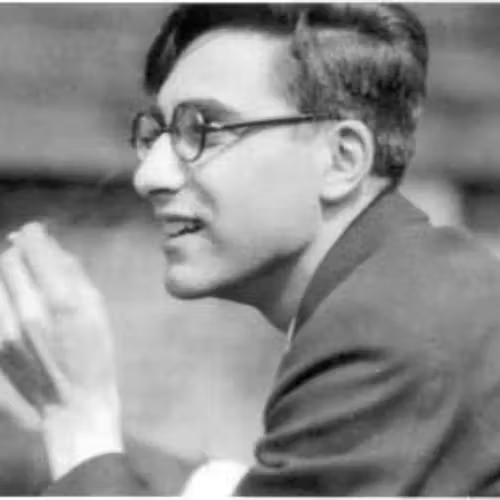
Quick Facts
- Born
- January 23, 1904
- Died
- May 12, 1978
- Movement
- Objectivist Poetry, Modernism
Louis Zukofsky remains one of the most influential yet often overlooked voices in twentieth-century American poetry. Known for his intellectual depth, linguistic precision, and commitment to artistic innovation, he played a central role in developing the Objectivist movement. Throughout his career, Zukofsky challenged conventional poetic forms by blending music, philosophy, politics, and everyday language into works that continue to inspire scholars, poets, and readers around the world.
Unlike many of his contemporaries, Louis Zukofsky believed that poetry should reveal the truth of ordinary life through careful observation and craftsmanship. His writings reflected his fascination with sound, structure, and meaning, making his poetry both challenging and rewarding. Although his work was not widely appreciated during his early career, later generations recognized his remarkable contribution to modern literature.
This biography explores the life, education, literary career, and lasting influence of Louis Zukofsky, highlighting how he became one of the defining figures of modern American poetry.
Early Life of Louis Zukofsky
Louis Zukofsky was born on January 23, 1904, in New York City, into a family of Jewish immigrants from the Russian Empire. His parents had emigrated in search of better opportunities, bringing with them a strong appreciation for education, language, and cultural traditions. Growing up on New York’s Lower East Side, Zukofsky experienced a vibrant multicultural environment where different languages, customs, and ideas intersected.
His first language was Yiddish, which was spoken at home by his family. As a child, he gradually became fluent in English while maintaining an awareness of his cultural heritage. This multilingual upbringing influenced his later fascination with language and its musical qualities.
The bustling streets of New York became an early source of inspiration for the young poet. Everyday conversations, city life, immigrant experiences, and urban rhythms later appeared throughout his poetry in subtle but meaningful ways.
Even during childhood, Louis Zukofsky displayed exceptional academic ability. He developed a passion for reading classical literature, philosophy, history, and music. These interests would eventually shape his unique poetic voice.
Education and Intellectual Development Of Louis Zukofsky
Louis Zukofsky attended public schools in New York before enrolling at Columbia University, where he studied English literature. His university years proved transformative, exposing him to both traditional literary classics and modern experimental writing.
At Columbia, he immersed himself in the works of William Shakespeare, John Milton, Geoffrey Chaucer, and classical Greek and Roman authors. At the same time, he discovered modern writers who were redefining poetry during the early twentieth century.
His education extended beyond literature. Zukofsky explored philosophy, economics, politics, linguistics, and music, believing that poetry could draw inspiration from every field of human knowledge. This interdisciplinary approach later became one of the defining characteristics of his work.
During his university years, he also began publishing poems and literary criticism. His early writings demonstrated remarkable technical skill and a willingness to experiment with structure and language.
Columbia University provided not only academic training but also connections with influential literary figures who would shape his future career.
The Beginning of Louis Zukofsky’s Literary Career
After graduating, Louis Zukofsky devoted himself almost entirely to writing. Rather than pursuing commercial success, he focused on developing poetry that reflected honesty, precision, and intellectual integrity.
His early poems attracted the attention of several prominent modernist writers, particularly Ezra Pound, whose encouragement helped introduce Zukofsky to a broader literary audience. Pound recognized the younger poet’s remarkable command of language and supported the publication of his work.
Zukofsky also formed friendships with other emerging poets who shared his interest in experimental literature. Together, they questioned conventional poetic traditions and searched for new ways of expressing modern experience.
Although financial stability remained a constant challenge, Louis Zukofsky continued writing with extraordinary discipline. He believed that poetry required patience, craftsmanship, and lifelong dedication rather than immediate recognition.
His earliest published works already displayed many qualities that later became hallmarks of his writing:
- Careful attention to rhythm
- Complex structural design
- Dense literary references
- Musical language
- Precise imagery
- Intellectual depth
These characteristics distinguished him from many poets of his generation.
Louis Zukofsky and the Objectivist Poetry Movement
The Origins of Objectivism
One of Louis Zukofsky’s greatest contributions to American literature was his leadership in the Objectivist poetry movement during the early 1930s.
The Objectivists were not a formal literary school with strict rules. Instead, they represented a group of poets who valued sincerity, clarity, and careful observation. They believed poetry should present objects, experiences, and emotions honestly without unnecessary ornamentation.
Louis Zukofsky played a key role in defining these principles through essays, criticism, and editorial work.
Core Principles of Objectivist Poetry
The movement emphasized several important ideas:
- Precision of language
- Honest observation
- Formal craftsmanship
- Structural unity
- Respect for everyday experience
- Attention to sound and rhythm
Rather than relying on emotional exaggeration, Objectivist poets sought to create poems that reflected reality with accuracy and artistic discipline.
Influence on Later Poetry Of Louis Zukofsky
Although the Objectivist movement initially remained relatively small, its influence expanded significantly after World War II. Many later poets admired Louis Zukofsky’s commitment to technical excellence and innovative thinking.
His ideas helped shape later developments in American experimental poetry, language poetry, and contemporary literary criticism.
Major Works of Louis Zukofsky
Throughout his career, Louis Zukofsky produced poetry, essays, translations, criticism, and prose. His writings consistently challenged readers while rewarding close attention.
“A”
His greatest achievement is undoubtedly the monumental long poem “A”, a project he worked on for nearly five decades.
Rather than following a traditional narrative, the poem combines autobiography, history, politics, music, philosophy, economics, and literary reflection into a complex artistic structure.
The work demonstrates Zukofsky’s extraordinary ability to weave multiple voices and themes into a unified poetic composition.
“A” remains one of the most ambitious long poems in American literature and continues to receive scholarly attention worldwide.
Shorter Poetry Collections
Alongside his epic project, Louis Zukofsky published numerous shorter poems that reveal his remarkable technical precision.
These poems often transform ordinary observations into intellectually rich experiences. A brief encounter, family conversation, or city scene becomes an opportunity to explore language, memory, and perception.
His shorter works display exceptional control over rhythm, line breaks, and sound patterns.
Essays and Literary Criticism
Zukofsky also wrote influential essays discussing poetry, literature, and artistic responsibility.
His criticism emphasized:
- Close reading
- Technical craftsmanship
- Historical awareness
- Precision in language
- Musical qualities of poetry
These essays helped explain the principles behind his own creative work while influencing future generations of poets and scholars.
The Distinctive Writing Style of Louis Zukofsky
Precision Above All
One defining characteristic of Louis Zukofsky’s poetry is extraordinary precision. Every word appears carefully selected for both meaning and sound.
Rather than using decorative language, he preferred concise expressions capable of conveying multiple layers of significance.
Musical Structure
Music played an essential role throughout Zukofsky’s writing process.
He often organized poems according to rhythms, repetitions, tonal patterns, and structural harmonies similar to musical compositions. This musical approach gives many of his poems a unique reading experience, rewarding readers who pay close attention to sound as well as meaning.
Intellectual Complexity
Louis Zukofsky never underestimated his audience. His poetry frequently incorporates references to philosophy, history, economics, classical literature, politics, and religion.
While this complexity can make his work challenging, it also allows readers to discover new meanings through repeated readings.
Everyday Experience
Despite his intellectual sophistication, Zukofsky often focused on ordinary moments from daily life.
Family conversations, urban landscapes, work, childhood memories, and simple observations become sources of profound artistic reflection. His poetry demonstrates that ordinary experiences can reveal universal truths when examined with care and imagination.
Personal Life of Louis Zukofsky
While Louis Zukofsky earned recognition for his intellectual poetry, his personal life was deeply rooted in family, music, and lifelong learning. He married Celia Thaew, a talented musician whose love for classical music greatly influenced his creative process. Their relationship was built on shared artistic interests, and music became an important element in both their lives.
The couple had one son, Paul Zukofsky, who later became an internationally respected violinist and conductor. Louis often drew inspiration from his family’s musical background, and many of his poems reflect rhythms, harmonies, and structures inspired by classical compositions.
Unlike many famous literary figures of his era, Zukofsky preferred a quiet and private lifestyle. He devoted much of his time to reading, writing, translating literature, and studying philosophy, history, economics, and music. Rather than seeking public attention, he focused on perfecting his craft, believing that poetry required patience, discipline, and lifelong dedication.
Throughout his life, he remained committed to literary excellence despite facing financial difficulties and limited public recognition. His determination to follow his artistic vision made him one of the most respected independent voices in American poetry.
Louis Zukofsky’s Influence on Modern Literature
Although Louis Zukofsky was never a bestselling poet during his lifetime, his influence on modern poetry has grown significantly over the decades.
Many contemporary poets admire his innovative use of language, technical precision, and willingness to challenge traditional poetic forms. His work helped expand the possibilities of modern poetry by showing that poems could combine intellectual depth with everyday experience.
His contributions inspired later literary movements, including experimental poetry, Language poetry, and other forms of avant-garde writing. Scholars continue to study his works because they offer fresh insights into language, culture, politics, and artistic expression.
Today, Louis Zukofsky is recognized as one of the most important American modernist poets, and his writings are taught in universities around the world.
Themes Found in Louis Zukofsky’s Poetry
Language and Sound
One of Zukofsky’s defining interests was the musical quality of language. He believed words should be appreciated not only for their meanings but also for their sounds and rhythms.
Everyday Life
Ordinary moments often became extraordinary subjects in his poetry. Family conversations, city streets, work, and daily observations all provided material for thoughtful artistic exploration.
History and Politics
Many of his poems reflect historical events, political ideas, and economic realities. Rather than offering direct commentary, he encouraged readers to think critically about society and human experience.
Family and Memory
His wife, son, and family life frequently appeared throughout his writings. These personal experiences added warmth and emotional depth to his intellectually complex poetry.
Music
Music influenced nearly every stage of Zukofsky’s writing. He often structured poems similarly to musical compositions, creating rhythm and harmony through carefully arranged language.
Legacy of Louis Zukofsky
Louis Zukofsky’s reputation continued to grow after his death. Critics who once considered his work difficult later recognized its originality and lasting significance.
Today, his poetry is valued for its precision, complexity, and innovation. Literary scholars regard him as one of the leading figures of twentieth-century American modernism and a pioneer of the Objectivist movement.
His long poem “A” remains one of the most ambitious achievements in American literature, demonstrating how poetry can combine autobiography, history, music, politics, philosophy, and language into a unified artistic vision.
Modern poets continue to draw inspiration from his techniques, while researchers explore new interpretations of his work every year. His commitment to craftsmanship, sincerity, and artistic independence ensures that his influence will remain important for generations to come.
Final Thoughts
Louis Zukofsky occupies a unique place in American literary history. Through his dedication to precision, innovation, and intellectual honesty, he helped redefine what modern poetry could achieve. As one of the founders of the Objectivist movement, he encouraged poets to approach language with clarity, discipline, and respect for everyday experience.
Although recognition came slowly during his lifetime, his writings have earned lasting admiration from readers, critics, and scholars alike. His ability to blend music, philosophy, history, and ordinary life into richly layered poetry makes his work timeless and continually relevant.
Whether exploring the complexities of language or capturing simple moments with remarkable precision, Louis Zukofsky demonstrated that poetry is both an art of sound and a way of understanding the world. His legacy continues to inspire writers and readers who value originality, craftsmanship, and thoughtful expression.
Poems by Louis Zukofsky Biography
No poems published yet for this poet.