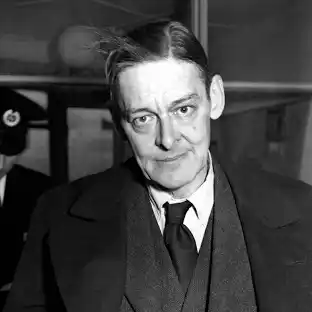
T.S. Eliot
Quick Facts
- Born
- September 26, 1888
- Died
- January 4, 1965
- Movement
- Modernism
- Known For
- The Waste Land, Four Quartets, The Love Song of J. Alfred Prufrock, The Hollow Men, Ash-Wednesday, Murder in the Cathedral, Old Possum's Book of Practical Cats
T.S. Eliot (Thomas Stearns Eliot) was one of the most influential poets, playwrights, literary critics, and editors of the twentieth century. Best known for transforming modern poetry, he received the 1948 Nobel Prize in Literature for his outstanding contribution to literature. His innovative writing style, philosophical depth, and exploration of modern life continue to inspire readers, scholars, and writers around the world.
Today, readers still search for T.S. Eliot poems, memorable T.S. Eliot quotes, and detailed information about T.S. Eliot because his works remain among the most studied pieces of English literature.
Born on September 26, 1888, in St. Louis, Missouri, United States, Eliot was raised in an educated and culturally rich family that encouraged literature and learning. He attended Smith Academy before continuing his education at Milton Academy in Massachusetts. Eliot later studied at Harvard University, where he earned both bachelor’s and master’s degrees and pursued doctoral studies in philosophy. During this period, he also spent time at the University of Paris (Sorbonne) and later attended Merton College, Oxford.
While still a university student, Eliot wrote several remarkable early poems that laid the foundation for modernist poetry. Among these were “The Love Song of J. Alfred Prufrock,” “Preludes,” “Portrait of a Lady,” and “Rhapsody on a Windy Night.” “The Love Song of J. Alfred Prufrock,” often regarded as one of the greatest modern T.S. Eliot poems, was first published in Poetry magazine in 1915 after the support of fellow poet Ezra Pound.
Eliot moved permanently to England during the First World War, a decision that greatly influenced both his personal life and literary career. In 1915, he married Vivienne Haigh-Wood, though the marriage became increasingly difficult due to emotional and health challenges. Their troubled relationship is widely believed to have influenced the emotional atmosphere of The Waste Land, one of the defining works of twentieth-century literature. After years of separation, Vivienne died in 1947. Eliot later married Esmé Valerie Fletcher in 1957. Valerie remained devoted to preserving Eliot’s literary legacy until her death in 2012.
In 1927, Eliot officially became a British citizen and joined the Anglo-Catholic Church, a spiritual transformation that deeply shaped his later writing. His religious beliefs became especially evident in works such as Ash-Wednesday and Four Quartets, where themes of faith, redemption, and time play central roles.
Among T.S. Eliot poems, The Waste Land (1922) stands as his greatest achievement. The poem captures the spiritual uncertainty and cultural fragmentation that followed the First World War and remains a landmark of modernist literature. Other celebrated works include The Hollow Men, Ash-Wednesday, Journey of the Magi, and Four Quartets, each reflecting Eliot’s evolving philosophical and religious outlook.
In addition to his poetry, Eliot established himself as a distinguished playwright. His dramas, including Murder in the Cathedral, The Family Reunion, The Cocktail Party, and The Confidential Clerk, expanded his influence beyond poetry. The Cocktail Party received the 1950 Tony Award for Best Play, further demonstrating his versatility as a writer.
Eliot also enjoyed an outstanding career as a literary critic, editor, and publisher. Between 1916 and 1921, he wrote nearly one hundred essays and reviews that helped shape modern literary criticism. From 1922 to 1939, he served as editor of the influential literary journal The Criterion, while from 1925 until his death, he worked as an editor and director at Faber & Faber, where he supported many important twentieth-century writers.
His achievements earned numerous international honors. In addition to receiving the Nobel Prize in Literature, Eliot was awarded the prestigious Order of Merit in the United Kingdom and the Presidential Medal of Freedom in the United States. His children’s poetry collection, Old Possum’s Book of Practical Cats, later inspired Andrew Lloyd Webber’s world-famous musical Cats, which became one of the most successful productions in theater history.
Readers frequently seek T.S. Eliot quotes because his writing explores timeless themes such as identity, love, memory, faith, loneliness, and the search for meaning. Many of his lines have become some of the most quoted passages in modern English literature and continue to appear in academic works, speeches, and popular culture.
Like several major literary figures of his era, Eliot’s legacy has also been the subject of critical debate. Some scholars have identified anti-Semitic language in portions of his poetry and prose, while others continue to examine these works within their historical and cultural context. These discussions remain an important part of understanding both Eliot’s influence and the complexities of his legacy.
Throughout his remarkable career, T.S. Eliot helped redefine modern poetry through innovative language, symbolism, and literary experimentation. His body of work continues to be studied across universities worldwide, ensuring that T.S. Eliot poems, T.S. Eliot quotes, and his literary criticism remain essential parts of English literature.
T.S. Eliot passed away on January 4, 1965, in London, England, at the age of 76. His influence on modern poetry, drama, and literary criticism continues to shape generations of readers and writers around the world.
Poems by T.S. Eliot