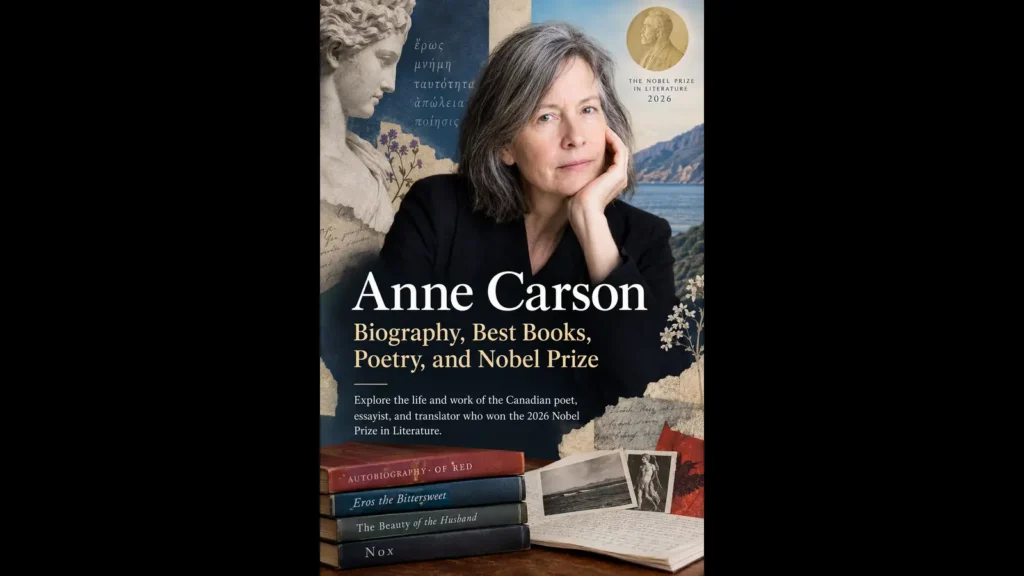
Anne Carson: Biography, Best Books, Poetry, and Nobel Prize
Quick Facts
- Born
- June 21, 1950
- Famous Quote
- “We are not the same, having seen the moon shine on the other side of the world.”
- Known For
- Experimental poetry, innovative literary style, classical Greek translations, and books such as Autobiography of Red, Eros the Bittersweet, and Nox.
Anne Carson is a Canadian poet, essayist, translator, and classicist born on June 21, 1950, in Toronto, Ontario. She won the 2026 Nobel Prize in Literature for her bold and inventive writing, which brings classical traditions into new forms of modern literature.
Her work connects ancient Greek stories with modern questions about love, identity, memory, grief, and human relationships. She is known for blending poetry, essays, fiction, translation, and visual art rather than following traditional literary rules. This unusual style has made her one of the most distinctive voices in contemporary poetry.
The best-known books by Anne Carson include Autobiography of Red, Eros the Bittersweet, The Beauty of the Husband, and Nox. Her writing may seem difficult at first, but it rewards readers who enjoy powerful ideas, unusual stories, and careful attention to language. This biography explores her early life, education, Nobel Prize, major books, poetry, writing style, and lasting influence on literature.
Anne Carson Quick Facts

| Fact | Details |
|---|---|
| Full name | Anne Carson |
| Date of birth | June 21, 1950 |
| Birthplace | Toronto, Ontario, Canada |
| Nationality | Canadian |
| Occupations | Poet, essayist, translator, classicist, and academic |
| Literary period | Contemporary literature |
| Main languages of scholarship | English and ancient Greek |
| Famous works | Autobiography of Red, Eros the Bittersweet, Nox, The Glass Essay |
| Major award | 2026 Nobel Prize in Literature |
| Other honors | T. S. Eliot Prize, Griffin Poetry Prize, MacArthur Fellowship |
| Literary style | Experimental poetry, verse novels, classical translation, and hybrid writing |
These details reflect Carson’s published biography, academic background, and major literary recognition.
Who Is Anne Carson?
Anne Carson is a contemporary Canadian writer whose work combines classical scholarship with creative literature. She is especially famous for turning ancient myths and ideas into fresh stories about modern human life.
Unlike writers who stay within one literary form, Carson moves between poetry, prose, essays, translation, and performance. This freedom allows her to explore subjects from different angles and challenge readers to think beyond familiar literary categories.
Her books often connect intellectual questions with personal feelings. A discussion of an ancient Greek poem might lead to questions about desire, while a modern story might explore grief through images, fragments, and historical references.
Where Was Anne Carson Born, and What Was Her Early Life Like?
Anne Carson was born in Toronto, Canada, on June 21, 1950. Her early interest in classical languages helped shape the career that later brought her international literary recognition.
As a high school student, Carson became interested in ancient Greek after a Latin teacher agreed to teach her the language during lunch breaks. This experience opened a path toward the study of ancient literature, especially Greek poetry and philosophy.
Carson studied at the University of Toronto, where she earned degrees in classics. Although she interrupted her studies more than once, she eventually completed her bachelor’s, master’s, and doctoral degrees in the field.
Her education gave her a deep understanding of ancient texts, but she did not use that knowledge only for academic research. She turned it into a creative resource, connecting old stories and ideas with the emotional questions people face today.
How Did Anne Carson Build Her Writing Career?
Anne Carson developed her career by bringing classical studies and experimental writing together. Her early work established her as a scholar and writer who could make ancient ideas feel personal and modern.
Her book Eros the Bittersweet, published in 1986, examined love and desire through ancient Greek literature. It helped establish her distinctive approach, in which literary analysis becomes part of a wider creative explorat.
In the 1990s, Carson gained wider attention through books such as Short Talks and Glass, Irony, and God. The latter contains The Glass Essay, a major long poem that connects heartbreak, memory, and reflections on Emily Brontë.
Her 1998 work Autobiography of Red brought her writing to a wider readership. Later works, including Nox, Float, and Wrong Norma, continued to test the boundaries between poetry, visual design, translation, and storytelling.
Did Anne Carson Win the Nobel Prize?
Yes. Anne Carson won the 2026 Nobel Prize in Literature, announced by the Swedish Academy on October 8, 2026. The award recognized her inventive writing and her creative engagement with classical literary traditions.
The prize recognized more than a single book or poem. Carson’s achievement lies in creating new forms of literature by bringing ancient stories and ideas into conversation with modern life.
Her work often moves between poetry, prose, translation, and visual elements. This approach challenges the idea that literature must follow fixed rules about genre, structure, or storytelling.
The Nobel Prize also brought fresh attention to her earlier books. For new readers, it offers an opportunity to discover how her study of the ancient world became a source of modern literary invention.
What Are the Best Books by Anne Carson?
The best Anne Carson books for new readers include Autobiography of Red, Eros the Bittersweet, Glass, Irony, and God, The Beauty of the Husband, and Nox. Each shows a different side of her writing.
Autobiography of Red (1998)
Autobiography of Red is a novel in verse that retells an ancient Greek myth through the life of Geryon, a red-winged figure who becomes a sensitive young man. The story explores love, identity, growing up, and the pain of rejection.
Carson transforms an ancient myth into a modern coming-of-age story. Its unusual mix of humor, emotional honesty, and mythology makes it a strong starting point for readers who are new to experimental poetry.
Eros the Bittersweet (1986)
Eros the Bittersweet is a book-length study of love and desire in ancient Greek literature. Carson examines the idea that longing often depends on distance between the person who desires and the person who is desired.
The book blends literary criticism, philosophy, and close reading. It is a good choice for readers interested in classical literature, the psychology of love, and the connection between language and emotion.
Glass, Irony, and God (1995)
Glass, Irony, and God is a poetry collection that includes The Glass Essay. The work explores emotional pain, memory, and the experience of a relationship ending.
The collection also brings Emily Brontë’s life and writing into the speaker’s reflections. It shows how Carson connects private experiences with literature and broader questions about human behavior.
The Beauty of the Husband (2001)
The Beauty of the Husband is a narrative poem subtitled A Fictional Essay in 29 Tangos. It examines attraction, betrayal, and the difficulty of understanding a relationship that has broken down.
The tango structure gives the work a sense of movement, repetition, and changing direction. Carson uses the idea of dance to explore the pull between beauty and truth, as well as the difference between loving someone and knowing them.
The book won the T. S. Eliot Prize, adding to her reputation as an important contemporary poet.
If Not, Winter: Fragments of Sappho (2002)
If Not, Winter presents Carson’s translations of surviving fragments by Sappho, the ancient Greek lyric poet. Many of Sappho’s poems survive only in incomplete pieces, leaving gaps in the original texts.
Carson preserves these gaps instead of hiding them by supplying missing words. This choice lets readers see the limits of what survives and experience the uncertainty that is part of studying ancient literature.
Nox (2010)
Nox is an experimental book about grief and Carson’s relationship with her late brother. It combines a translation of a poem by the Roman poet Catullus with photographs, documents, notes, and personal memories.
The book unfolds like a long scrapbook, turning the physical form of the book into part of its meaning. Its fragments reflect how difficult it can be to understand another person, especially after death.
Red Doc> (2013)
Red Doc> revisits characters and ideas from Autobiography of Red in a more fragmented and experimental form. It follows Geryon into later life and explores trauma, relationships, and the struggle to live with the past.
Readers who enjoyed the emotional world of Autobiography of Red can use this book to see how Carson develops her characters and changes her approach to storytelling.
Float (2016)
Float is a collection of separate booklets that readers can approach in different orders. It brings together experimental writing and explores how a book can be arranged, handled, and read.
The collection reflects Carson’s interest in breaking away from the standard shape of a poetry book. Its structure makes the reading experience part of the creative work itself.
Norma Jeane Baker of Troy (2019)
Norma Jeane Baker of Troy brings the story of Helen of Troy into conversation with the life and public image of Marilyn Monroe. It explores beauty, fame, desire, and the way society turns women into symbols.
By connecting an ancient Greek figure with a modern celebrity, Carson shows how stories about beauty and public attention can repeat across different historical periods.
Wrong Norma (2024)
Wrong Norma is a poetry collection that continues Carson’s interest in surprising connections, unusual forms, and abrupt changes in subject. Its pieces do not always follow one clear narrative, inviting readers to find meaning through images, language, and contrast.
The collection is a useful example of Carson’s later work, in which experimentation is not an extra feature but a central part of how the writing operates.
What Are Anne Carson’s Most Famous Poems?
Anne Carson has written many poems and poetry collections, but there is no single authoritative count of every individual poem she has produced. Her work includes long poems, short pieces, verse novels, fragments, translations, and hybrid books.
Her poetry often explores desire, grief, identity, memory, and the limits of language. She uses free verse, dramatic voices, classical references, and broken or unusual structures to express feelings that conventional storytelling may not fully capture.
The Glass Essay (1995)
Published in Glass, Irony, and God, The Glass Essay follows a speaker dealing with heartbreak while reflecting on Emily Brontë and her novel Wuthering Heights. Its shifts between personal memory and literary reflection show how reading can shape the way people understand their own experiences.
The poem is among Carson’s most widely discussed works because it joins emotional honesty with close attention to literature. Its changing sections mirror the speaker’s effort to make sense of pain and memory.
The Fall of Rome (2000)
Associated with Men in the Off Hours, The Fall of Rome draws on historical and cultural images to consider decline, change, and the passage of time. Carson’s approach connects the distant past with questions that remain relevant to modern readers.
The work demonstrates how she can use history without turning a poem into a simple historical account. Instead, the past becomes a way to think about instability and human experience.
The Albertine Workout (2014)
The Albertine Workout takes its inspiration from Marcel Proust’s In Search of Lost Time, especially the character Albertine. It combines numbered observations and literary analysis to explore desire, memory, and the difficulty of knowing another person.
The work is a clear example of Carson’s hybrid method. It sits between criticism and poetry, showing how a writer can use another author’s fictional world to ask new questions.
Short Talks (1992)
Short Talks is a collection of brief prose poems built around compact observations, unexpected images, and shifts in thought. Each piece offers a small opening into a larger idea rather than a fully explained story.
The collection shows Carson’s skill at making short forms feel intellectually rich. Its brevity also makes it a useful entry point for readers who want to experience her unusual voice without starting with a longer work.
Autobiography of Red (1998)
Although it is a novel in verse rather than a single poem, Autobiography of Red is one of Carson’s best-known poetic works. Its retelling of Geryon’s myth uses an ancient story to explore identity, desire, heartbreak, and growing up.
The red-winged Geryon becomes an outsider whose artistic vision shapes the way he sees the world. The book’s mixture of myth, humor, and emotional depth makes it one of the strongest examples of Carson’s creative range.
The Beauty of the Husband (2001)
This book-length narrative poem follows the painful movement of a relationship through attraction, betrayal, and reflection. Its 29 tango sections give the story a pattern of movement and return.
The work is notable for how it examines the difference between the ideal image of a partner and the reality of that person’s actions. It also shows Carson’s ability to use a formal structure to shape a personal story.
Wrong Norma (2024)
Wrong Norma includes poems that resist a single subject or consistent narrative. Its unexpected connections and changes in tone show Carson’s ongoing interest in the freedom of poetic form.
For readers interested in her recent poetry, the collection offers an example of how she continues to challenge familiar expectations about what a poem or poetry collection should look like.
What Makes Anne Carson’s Writing Style Unique?
Anne Carson’s writing style is distinctive because it blends poetry, scholarship, translation, storytelling, and visual art. Rather than treating these as separate activities, she allows them to shape one another.
She Combines Ancient and Modern Worlds
Carson often draws on Greek myths, ancient poets, and classical philosophy. She places these sources beside modern characters and situations, allowing old stories to shed light on present-day emotions.
This method makes classical literature feel less like a distant subject and more like a living source of questions about love, power, identity, and loss.
She Mixes Poetry with Essays and Fiction
Her books may include a poem, an essay, a fictional story, or a translation within the same work. This mixture allows her to examine an idea through several forms rather than relying on one fixed structure.
For readers, this means that her books can feel different from traditional poetry collections. Some require slow reading and reflection, while others offer a more direct story.
She Uses Fragments and Gaps
Carson often leaves gaps, breaks, and unfinished elements in her writing. These choices can reflect the way memory works or the limits of what people can know about the past.
In If Not, Winter, for example, the missing parts of ancient poems remain visible. In Nox, fragments of text and personal records reflect the difficulty of reconstructing a life through incomplete evidence.
She Connects Intellectual Ideas with Emotion
Carson’s work can be deeply scholarly, but it is not limited to abstract ideas. She uses literary research to explore experiences such as heartbreak, desire, grief, and loneliness.
This combination is one reason her writing appeals to both academic readers and people seeking literature that addresses personal struggles.
What Themes Appear Most Often in Anne Carson’s Poetry?
Anne Carson’s poetry frequently explores love, absence, identity, grief, memory, and the relationship between language and experience. These themes connect her classical interests with the concerns of contemporary life.
- Love and desire: Her work examines why people long for others and how distance can shape attraction.
- Loss and grief: Books such as Nox explore how memory and incomplete knowledge affect the experience of mourning.
- Identity and difference: Autobiography of Red presents an outsider whose unusual body and artistic vision shape his experience of the world.
- Memory and the past: Carson often shows how personal memories interact with books, myths, and historical records.
- Beauty and truth: The Beauty of the Husband questions whether attraction and beauty help people understand one another or hide difficult realities.
- Language and silence: Her translations and fragmented forms draw attention to what words can express and what remains missing.
These themes are not always presented as clear lessons. Carson often leaves room for uncertainty, asking readers to consider several meanings instead of accepting one simple answer.
How Did Ancient Greek Literature Influence Anne Carson?
Ancient Greek literature influenced Anne Carson through her academic study of classical languages, poetry, philosophy, and myth. She uses this knowledge to create modern works that preserve the strangeness of the ancient world while making its questions feel familiar.
Her interest in Greek literature began during her school years and continued through her university education in classics. This background helped her develop an approach that combines close reading with creative experimentation.
Her translations of Sappho and Greek plays show her care for the surviving words and the gaps in ancient texts. Her creative writing also reworks Greek myths, as seen in Autobiography of Red and Norma Jeane Baker of Troy.
Rather than simply retelling old stories, Carson changes their settings, voices, and forms. The result is literature that asks how ancient ideas about desire, beauty, identity, and fate continue to influence modern life.
What Awards Has Anne Carson Received?
Anne Carson has received major literary honors, including the 2026 Nobel Prize in Literature, the T. S. Eliot Prize, Griffin Poetry Prizes, and a MacArthur Fellowship. These awards recognize her contribution to poetry and experimental literature.
Her major honors include:
- 2026 Nobel Prize in Literature: Recognized her inventive body of work and engagement with classical traditions.
- T. S. Eliot Prize: Awarded for The Beauty of the Husband.
- Griffin Poetry Prize: One of the major poetry honors associated with her career.
- MacArthur Fellowship: Recognized her exceptional creative and intellectual work.
- Governor General’s Award: Among the Canadian literary honors she has received.
- Member of the Order of Canada: Recognition of her contributions to Canadian literature and culture.
The Nobel Prize brought international attention to a career that had already earned strong recognition among readers, scholars, and fellow writers.
Why Is Anne Carson Important to Contemporary Literature?
Anne Carson is important because she has expanded what poetry and literary writing can look like. Her work shows that poems can interact with scholarship, fiction, translation, performance, and visual design without losing their emotional power.
She has also offered new ways to approach classical literature. Instead of presenting ancient texts as finished objects, she makes their gaps, questions, and uncertainties part of the reading experience. This approach helps readers see translation as both a scholarly task and a creative act.
Her influence can be seen in the attention given to hybrid writing and genre-crossing literary forms. Carson’s books encourage writers to experiment with structure and encourage readers to accept ambiguity rather than demand a single answer.
Her Nobel Prize in 2026 further confirmed the international significance of this approach, bringing her distinctive combination of classical knowledge and modern invention to a wider audience.
Anne Carson Quotes: What Should Readers Know?
Anne Carson quotes are often searched for because her writing explores memorable ideas about love, memory, desire, and loss. Her work is known for concise language and surprising connections, but individual lines should be checked against reliable editions before being attributed to her.
Because Carson’s books are still under copyright, this biography does not reproduce a collection of her copyrighted lines. Readers looking for quotations can consult her published books, especially The Glass Essay, Autobiography of Red, and Eros the Bittersweet, to find the original wording in context.
Reading the surrounding passage is particularly important with Carson. A short line may appear simple on its own, while the larger work connects it to mythology, philosophy, or a character’s changing emotions. Understanding that context gives readers a more accurate sense of her ideas and writing style.
Conclusion
Anne Carson has built a remarkable place in contemporary literature by bringing ancient stories into conversation with modern life. Her work moves between poetry, essays, translation, and visual art, creating a style that is difficult to place in one category. Books such as Autobiography of Red, The Glass Essay, and Nox show how she explores love, identity, memory, and grief through unusual forms and powerful ideas.
Her 2026 Nobel Prize in Literature recognized the originality of a career shaped by classical learning and creative freedom. For new readers, Autobiography of Red is a useful place to begin, while Eros the Bittersweet offers a deeper look at her intellectual interests. Whatever book readers choose, Carson invites them to slow down, question familiar ideas, and discover new meanings in language, history, and human relationships.
Frequently Asked Questions About Anne Carson
Anne Carson uses an experimental style that combines poetry, prose, translation, scholarship, and visual art. Her writing often includes classical references, fragmented structures, and open-ended questions about human experience.
Her work frequently explores love, desire, identity, memory, grief, beauty, and the limits of language. She often uses ancient myths and literary texts to examine these subjects from a modern perspective.
Autobiography of Red is a novel in verse that reimagines the Greek myth of Geryon. Carson presents Geryon as a red-winged young man who experiences love, rejection, and the challenge of finding his place in the world.
Yes. Anne Carson has translated works from classical Greek literature, including If Not, Winter: Fragments of Sappho and the Greek tragedy Electra. Her translations are known for respecting the gaps and uncertainties in ancient texts.
Nox is an experimental book about grief and Carson’s late brother. It combines personal documents, photographs, notes, and a translation of a poem by the Roman poet Catullus to explore memory and loss.
Anne Carson is important because she challenges traditional boundaries between poetry, fiction, scholarship, and visual art. Her work has expanded the possibilities of contemporary literature and earned international recognition, including the 2026 Nobel Prize in Literature.
Read more about Poets
Poems by Anne Carson: Biography, Best Books, Poetry, and Nobel Prize
No poems published yet for this poet.