
The Laughing Heart by Charles Bukowski
The Laughing Heart by Charles Bukowski is a free-verse poem about personal freedom, self-worth, and the importance of choosing how to live despite hardship. Written in Bukowski’s direct, conversational style, it encourages readers to resist forces that reduce their lives to passive submission and to recognize opportunities for change when they appear. Its short lines, repeated phrases, and images of light and darkness turn a message of personal responsibility into an urgent appeal for hope. Although the poem confronts death and human limitations, its central concern is the possibility of finding meaning, dignity, and moments of victory within the life a person has.
Meaning and Summary of The Laughing Heart
The central meaning of The Laughing Heart is that people should protect their independence, recognize their own worth, and make active choices rather than surrendering to circumstances. Bukowski begins by insisting that life belongs to the individual, warning against allowing it to be forced into a condition of submission. He then introduces the possibility of escape and compares hope to a small light that can challenge darkness.
The poem does not promise that suffering will disappear or that every opportunity will lead to success. Instead, it encourages alertness, courage, and action. The speaker suggests that opportunities may arrive unexpectedly, but recognizing them is only the first step; people must also take them.
The reference to death introduces an important limitation. Human beings cannot defeat mortality, yet they can experience meaningful victories while alive. By returning to the idea that life belongs to the individual, Bukowski emphasizes the importance of recognizing its value before it passes. The final lines offer an affirmation of human worth, presenting existence as something capable of bringing delight rather than merely enduring pain.
Themes in The Laughing Heart
One of the strongest themes in The Laughing Heart is personal freedom. The opening declaration establishes that an individual’s life should not be surrendered to oppressive circumstances. The image of being violently forced into submission suggests that social expectations, discouragement, fear, or personal difficulties can diminish a person’s sense of control. Bukowski does not identify one specific oppressor, allowing the warning to apply to different experiences.
Hope is another central theme. The poem’s contrast between light and darkness presents hope as something that may be limited but still powerful enough to make a difference. Bukowski does not suggest that people must feel happy all the time. Rather, he argues that even a small possibility of improvement can challenge despair.
The poem also explores mortality and the value of the present. Its recognition that death cannot ultimately be defeated makes the encouragement to live more urgent. Human beings cannot control how much time they have, but they can influence how they use it.
Finally, the poem affirms individual worth. The speaker’s description of the reader as marvelous challenges feelings of insignificance and defeat. The ending imagines life not merely as a burden to survive but as an experience that can still contain pleasure, discovery, and possibility.
Form, Meter, and Rhyme Scheme
The Laughing Heart is written in free verse, without a fixed rhyme scheme, regular meter, or conventional stanza pattern. Its short lines and irregular rhythm support the poem’s direct, conversational character. Rather than relying on musical rhyme, Bukowski builds momentum through repetition, sentence structure, and changes in pace.
The poem’s lowercase presentation also contributes to its informal appearance. Without conventional capitalization at the beginnings of sentences, the lines seem less concerned with formal rules and more focused on the urgency of their message. This visual simplicity complements the speaker’s insistence on personal independence.
Repetition provides the poem with a loose structural framework. The return to the declaration about owning one’s life creates a sense of circularity: the speaker begins with personal autonomy and returns to it after discussing hope, opportunity, and death. Short commands interrupt longer statements, making the poem sound like a series of instructions delivered directly to the reader.
Enjambment appears when a sentence continues beyond a line break. For example, the qualification that a light may be small continues into the statement about its power against darkness. The break briefly emphasizes the possibility of weakness before the next line overturns that impression. This interplay between lineation and meaning gives the free-verse structure much of its expressive force.
Literary and Poetic Devices in The Laughing Heart
Bukowski uses several literary devices to communicate his message without complicated language. The most striking is metaphor. The image of life being “clubbed into dank submission” compares the loss of personal freedom to a physical assault. The harsh verb makes passivity seem like something imposed through force rather than a harmless state of mind.
Light and darkness form the poem’s central symbolic contrast. Light represents hope, opportunity, and the possibility of meaningful living, while darkness suggests despair, limitation, or emotional defeat. The light does not need to be brilliant to matter; its importance comes from its ability to resist the darkness.
Direct address is equally important. By speaking to the reader as “you,” the speaker creates an intimate, almost advisory voice. The commands to remain alert, recognize opportunities, and act on them turn the poem into an appeal for participation rather than passive reflection.
Repetition reinforces this effect. The recurring declaration of personal ownership acts as a refrain, reminding readers of the principle behind the poem’s advice. The repeated commands also create urgency, while the plain diction makes the ideas accessible.
Personification appears in the treatment of death as an opponent that people can defeat only in a limited sense. The poem distinguishes between overcoming mortality itself and achieving meaningful victories during one’s lifetime. The reference to the gods introduces a more mysterious dimension, suggesting that existence may hold possibilities that the individual cannot fully predict.
Line-by-Line Analysis
The poem progresses from a declaration of independence to a recognition of opportunity, then to mortality and an affirmation of human worth.
The opening two lines establish the central conflict. The speaker first claims life as the reader’s own, then warns against allowing it to be crushed into submission. The contrast between ownership and oppression is important: possessing a life does not automatically mean living it freely. The warning challenges readers to consider whether fear, routine, social pressure, or disappointment has begun to control their choices.
The next group of short statements introduces vigilance and hope. The speaker insists that alternatives exist and that a source of light remains possible, even when it is difficult to see. The qualification that the light may be limited makes the encouragement more convincing. Hope is not presented as the absence of hardship; it is the possibility of resisting hardship despite its presence.
The return of the instruction to remain watchful leads into the poem’s discussion of opportunity. The gods are presented as figures who offer chances, but the reader must recognize and accept them. The two brief commands that follow separate awareness from action. A person can notice an opportunity and still fail to act, so the poem treats both recognition and decision as necessary parts of change.
The reflection on death introduces the poem’s most significant limitation. The speaker acknowledges that mortality cannot be overcome permanently, then distinguishes it from the smaller victories available within life. The qualification that these victories happen sometimes matters: Bukowski does not promise constant triumph. Instead, he suggests that repeated experiences of agency and achievement can gradually increase the light available to a person.
The final movement returns to the opening declaration and adds an instruction to recognize life while it remains available. The speaker then directly affirms the reader’s worth before imagining the gods as eager to bring delight. The ending shifts the poem from resistance toward receptivity. Living well involves not only fighting oppression but also accepting the possibility of joy.
Historical and Literary Context
Charles Bukowski was a German-born American poet and novelist whose writing often explored urban hardship, alienation, work, and the lives of people on society’s margins. His literary style is associated with direct language, free verse, and an unpolished voice that rejects unnecessary formality. These qualities are evident in The Laughing Heart, where brief sentences and everyday words carry a serious philosophical message.
The poem was published in Prairie Schooner in 1993 and later appeared in a 1996 Black Sparrow Press publication titled The Laughing Heart. The Bukowski database dates its composition to around 1993, near the end of his life.
This timing provides relevant context for the poem’s attention to mortality, although the text alone cannot establish exactly what personal experiences inspired each line. Its combination of death awareness and encouragement to embrace life reflects a recurring concern in Bukowski’s writing: how people can find meaning within an imperfect world.
The Laughing Heart: Full Text and Printable Reading
Readers searching for the laughing heart charles bukowski full text can read the complete poem displayed above this analysis on this page. Keeping the poem and its interpretation together makes it easier to follow the progression from the opening declaration of personal freedom to the final affirmation of human worth.
For a printable copy, readers can use their browser’s print function and select Save as PDF to save the webpage, including the poem and analysis. Check the print preview to ensure that the poem’s line breaks remain intact. Preserving those breaks matters because Bukowski’s short lines, pauses, and shifts in emphasis contribute to the poem’s rhythm and meaning.
The poem is sometimes searched for as The Laughing Heart lyrics, but it is a poem rather than a song lyric written for a musical composition. Its concise, memorable statements may explain why readers encounter it in spoken-word readings and other inspirational contexts.
Conclusion
The Laughing Heart remains compelling because it offers hope without pretending that life is easy. Charles Bukowski acknowledges the realities of darkness and death while insisting that people can still recognize opportunities, resist defeat, and experience meaningful moments of joy. Its free-verse structure and blunt language reinforce the idea that living fully does not require perfect circumstances or elaborate explanations. The poem asks readers to recognize their own worth while they still have the opportunity to act on it. Ultimately, its message is both a warning against surrender and an invitation to participate more consciously in life.
Frequently Asked Questions
The main message is that people should take ownership of their lives rather than surrendering to despair or outside pressures. Bukowski encourages readers to remain alert to opportunities, act when possibilities arise, and recognize their own worth despite life’s difficulties and the certainty of death.
The title suggests a spirit capable of joy even when life presents serious difficulties. The poem’s emphasis on light, opportunity, and delight supports an interpretation of the heart as a symbol of inner vitality. The title does not appear literally in the poem’s body, so this interpretation comes from its overall message rather than an explicit definition.
Its principal themes include personal freedom, hope, resilience, mortality, opportunity, and self-worth. The contrast between light and darkness expresses the struggle between possibility and despair, while the discussion of death emphasizes the importance of using the time available to live meaningfully.
The poem uses free verse, with no regular rhyme scheme or consistent metrical pattern. Its short lines, repeated statements, direct address, and command-like sentences create rhythm and emphasis without following a traditional poetic structure.
The poem is dated to approximately 1993 and was published in Prairie Schooner that year. It was subsequently included in a Black Sparrow Press publication titled The Laughing Heart in 1996.
Read about other Poems
About Charles Bukowski
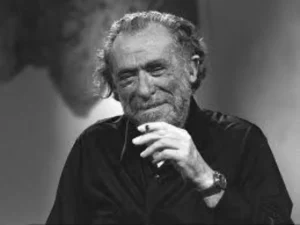
Charles Bukowski was a German-American poet born on August 16, 1920, in Andernach, Germany, and best known for his raw poetry and fiction about ordinary life. He grew up in Los Angeles, where poverty, difficult…
Read Full Biography →More Poems by Charles Bukowski