
Jack Kerouac: Life, Books, Poems, and On the Road
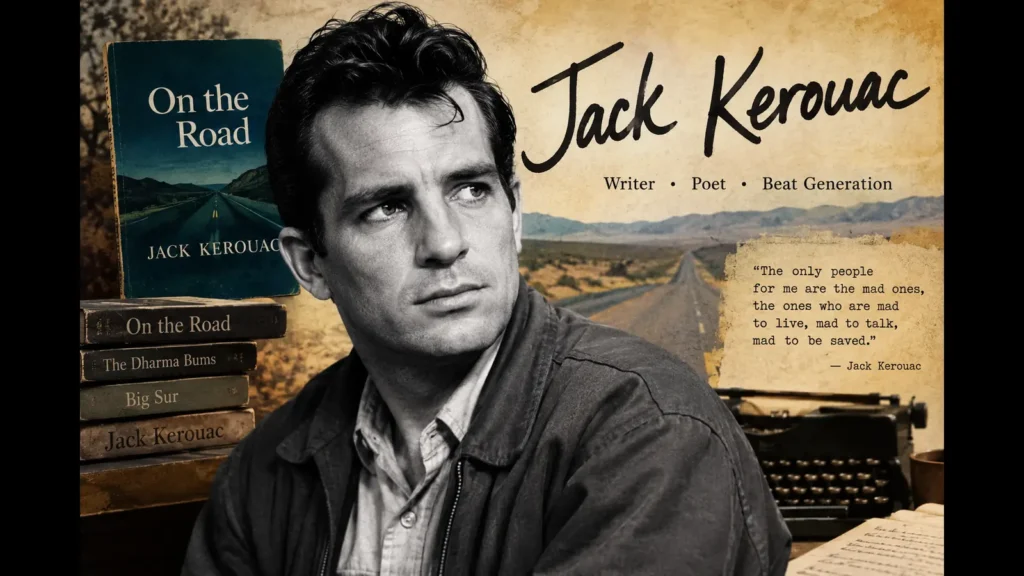
Quick Facts
- Born
- March 12, 1922
- Died
- October 21, 1969
- Movement
- Beat Generation
- Known For
- On the Road
Jack Kerouac was an American novelist and poet born on March 12, 1922, best known for On the Road. Born Jean-Louis Lebris de Kerouac in Lowell, Massachusetts, he became one of the most recognizable writers of the Beat Generation. His work mixed travel, jazz, spirituality, friendship, loneliness, Buddhism, Catholicism, and the search for freedom.
His 1957 novel On the Road turned him into a literary celebrity and helped define the Beat Generation. Yet his career was much larger than one novel. He wrote poetry, novels, journals, essays, sketches, haiku, and experimental prose, often drawing directly from his own life and travels.
Today, readers still search for his books, poems, quotes, portraits, final years, and the famous On the Road scroll. His writing remains important because it captured the restless mood of postwar America while challenging traditional ideas about how literature should sound and move.
Quick Facts About Jack Kerouac
| Fact | Details |
|---|---|
| Full name | Jean-Louis Lebris de Kerouac |
| Born | March 12, 1922 |
| Died | October 21, 1969 |
| Birthplace | Lowell, Massachusetts, United States |
| Death place | St. Petersburg, Florida, United States |
| Nationality | American |
| Heritage | French-Canadian |
| Occupation | Novelist, poet, writer, artist |
| Literary movement | Beat Generation |
| Best-known work | On the Road |
| Major books | On the Road, The Dharma Bums, Big Sur, The Subterraneans, Visions of Cody |
| Famous poetry | Mexico City Blues, Book of Haikus, Book of Blues |
| Burial place | Edson Cemetery, Lowell, Massachusetts |
| Age at death | 47 |
Who Was Jack Kerouac?
Jack Kerouac was a 20th-century American novelist and poet who became a leading voice of the Beat Generation.
He grew up in Lowell in a French-speaking French-Canadian family. His early life in a working-class neighborhood strongly shaped his memories, language, and later fiction. He did not begin life as the famous counterculture writer often shown in popular culture.
Kerouac attended Lowell High School and later studied at Columbia University in New York. His time in New York introduced him to writers and artists who would become central to the Beat movement, including Allen Ginsberg and William S. Burroughs.
His friendship with Neal Cassady was especially important. Cassady became the model for Dean Moriarty in On the Road, while Kerouac transformed parts of his own experiences into the narrator Sal Paradise.
Where Was Jack Kerouac Born?
Jack Kerouac was born in Lowell, Massachusetts, on March 12, 1922.
His parents, Leo and Gabrielle Kerouac, were French-Canadian immigrants from Quebec. Kerouac grew up speaking French before becoming fluent in English, and his French-Canadian background remained an important part of his identity.
Lowell later became central to his literary mythology. Several of his books return to childhood, family, Catholic faith, local streets, friendships, and memories of growing up in the city.
The National Park Service notes that his writing repeatedly drew on Lowell, New York City, and his travels around the United States. His childhood memories became important material for works such as The Town and the City and Visions of Gerard.
How Did Jack Kerouac Become Part of the Beat Generation?
Jack Kerouac became a central Beat writer through his friendships with Allen Ginsberg, William S. Burroughs, Neal Cassady, and other New York writers.
The Beat Generation was a literary and cultural movement that questioned conventional postwar American life. Its writers explored freedom, sexuality, spirituality, travel, jazz, poverty, drugs, and alternative ways of living.
Kerouac helped give the movement its name and became its most famous novelist after On the Road appeared in 1957. His success made him an unexpected public symbol of rebellion.
The label, however, simplified his personality and writing. Kerouac was deeply influenced by Catholicism and later Buddhism. His books often show a search for spiritual meaning rather than rebellion for its own sake.
When Did Jack Kerouac Write On the Road?
Jack Kerouac wrote the famous first draft of On the Road in April 1951, after developing the project for several years.
Kerouac had been thinking about a road novel since the late 1940s. His travels with Neal Cassady and other friends gave him material, but he struggled to find a style that felt spontaneous enough.
In April 1951, he created a continuous manuscript by taping sheets of paper together and feeding the long strip through his typewriter. He produced the main draft in roughly three weeks.
The manuscript became famous as the Jack Kerouac scroll. The original typescript was almost 120 feet long and had no normal paragraph breaks. Later editing and revision were required before the novel was published by Viking in 1957.
What Is the Jack Kerouac Scroll?
The Jack Kerouac scroll is the continuous manuscript on which the first major draft of On the Road was typed in 1951.
Kerouac made the scroll by connecting long strips of paper so he would not have to stop to insert new sheets into his typewriter. The unusual format matched his desire to keep his writing moving without interruptions.
The manuscript became one of the most famous literary artifacts of modern American literature. Its physical form has become almost as famous as the novel itself.
The scroll is important because it shows how Kerouac connected his idea of spontaneous prose with the physical act of writing. It was not simply a strange piece of paper; it was part of his experiment with speed, rhythm, memory, and continuous thought.
On the Road by Jack Kerouac: Summary
On the Road follows Sal Paradise and Dean Moriarty as they travel across the United States in search of experience, freedom, friendship, and meaning.
Sal Paradise is a young writer who becomes fascinated by Dean Moriarty, a restless and energetic traveler. Dean is based largely on Neal Cassady, Kerouac’s close friend and traveling companion.
The characters move through places such as New York, Denver, San Francisco, and Mexico. Their journeys bring encounters with musicians, writers, workers, lovers, strangers, and other travelers.
The book is more than a travel story. Beneath the movement is a search for identity and spiritual meaning. Jazz, friendship, desire, loneliness, and the idea of the open road all shape the story.
The novel became a classic Jack Kerouac novel because it presented postwar American life through fast-moving prose and a voice that felt different from conventional literary fiction.
Why Is On the Road Important?
On the Road is important because it helped define Beat literature and changed how many readers viewed travel, freedom, youth, and American identity.
When the novel appeared in 1957, Kerouac suddenly became famous. The book was widely discussed as a representation of a new generation that felt dissatisfied with traditional social expectations.
Its influence extended beyond literature. Musicians, filmmakers, travelers, artists, and later counterculture movements found inspiration in its celebration of movement and experience.
At the same time, modern readers often approach the novel more critically. Its treatment of women, race, relationships, alcohol, drugs, and freedom can raise difficult questions. Understanding those tensions makes the book more useful rather than less important.
Jack Kerouac’s Writing Style and “Spontaneous Prose”
Kerouac’s writing style is known for speed, rhythm, long sentences, repetition, jazz influence, and an attempt to capture thought as it happens.
He called his approach spontaneous prose. The idea was not simply to write quickly without planning. Kerouac wanted prose to preserve the energy of memory, speech, music, emotion, and immediate experience.
Jazz was particularly important to him. He admired musicians such as Charlie Parker and Thelonious Monk, and he tried to create literary rhythms that could move like improvised music.
His style can therefore feel breathless, loose, repetitive, and highly personal. Instead of carefully separating every thought, he often allowed one memory or image to lead naturally into another.
The National Park Service describes his later work as developing a lyrical, stream-of-consciousness style, while the Library of America connects his prose directly with his poetic experiments.
What Were Jack Kerouac’s Main Themes?
Kerouac repeatedly explored freedom, travel, friendship, spirituality, loneliness, mortality, and the search for meaning.
- The open road: Travel represents freedom, change, risk, and the desire to escape routine.
- Friendship: His relationships with Neal Cassady, Allen Ginsberg, and others became major sources of literary material.
- Spiritual searching: Catholicism, Buddhism, meditation, and ideas about compassion appear throughout his work.
- Jazz and music: Rhythm and improvisation shaped both his poetry and prose.
- Loneliness: Behind the excitement of travel is often a deep fear of isolation and loss.
- Death and memory: Kerouac frequently returned to family deaths, aging, childhood memories, and the temporary nature of life.
- American identity: His journeys became a way to explore different communities and regions of the United States.
Jack Kerouac’s Major Books
Kerouac wrote many novels, but On the Road, The Dharma Bums, Big Sur, and The Subterraneans are among his most important works.
On the Road
Published in 1957, On the Road remains his best-known novel. It transforms Kerouac’s travels and friendships into a story about movement, youth, jazz, friendship, and spiritual searching.
The Dharma Bums
Published in 1958, The Dharma Bums explores Buddhism, nature, poetry, friendship, and the search for a simpler life. Gary Snyder influenced the character Japhy Ryder.
The book shows a different side of Kerouac from the restless road traveler. Mountains, meditation, and spiritual questions become central to the story.
The Subterraneans
Published in 1958, The Subterraneans focuses on relationships, desire, the literary world, and emotional instability. It draws heavily from Kerouac’s experiences in San Francisco.
Big Sur
Published in 1962, Big Sur is one of Kerouac’s darker books. It reflects his growing discomfort with fame, drinking, and the public image created by On the Road.
The book is valuable for understanding what happened after the romantic image of the Beat writer became attached to his real life.
Visions of Cody
Visions of Cody grew from Kerouac’s intense interest in Neal Cassady and his experiments with voice and structure. It pushed his spontaneous prose ideas further than On the Road.
The novel was published posthumously in 1972, although parts had appeared earlier. It is especially useful for readers who want to understand his experimental writing rather than only his popular image.
Jack Kerouac Books: Which One Should You Read First?
Start with On the Road if you want the clearest introduction to Kerouac’s life, style, characters, and Beat Generation background.
It is the easiest starting point because it connects many of the subjects associated with him: travel, jazz, friendship, youth, America, and freedom.
Readers interested in Buddhism and nature can move next to The Dharma Bums. Readers who want a more painful and mature view of his life may prefer Big Sur.
For experimental writing, Visions of Cody is a stronger choice. For poetry, Mexico City Blues offers the best introduction to his jazz-inspired poetic style.
Jack Kerouac Poems and Poetry
There is no single authoritative count of every poem Kerouac wrote, but his poetry survives in seven major poetic works plus many uncollected poems.
Kerouac’s poetry was not a minor part of his career. The Library of America collected his major poetic works in a 780-page volume containing Mexico City Blues, The Scripture of the Golden Eternity, Book of Blues, Pomes All Sizes, Old Angel Midnight, Desolation Pops, Book of Haikus, and additional uncollected poems.
His poetry often combines jazz rhythm, Buddhist thought, everyday observation, travel, loneliness, humor, and spiritual questions. He experimented with haiku, blues forms, free verse, prose poetry, Buddhist writing, and spoken-word rhythms.
Mexico City Blues
Published in 1959, Mexico City Blues contains 242 numbered choruses and is probably the best-known example of Kerouac’s poetry. It treats poetry almost like jazz improvisation.
The collection moves through ideas about consciousness, death, desire, Buddhism, music, friendship, and everyday life. Its numbered structure creates the feeling of a long musical performance.
The Scripture of the Golden Eternity
This work combines poetry, Buddhist ideas, and spiritual reflection. Kerouac uses short statements and poetic images to explore emptiness, consciousness, existence, and enlightenment.
It shows why it is misleading to describe him only as a road writer. His spiritual interests became increasingly important as his career developed.
Book of Blues
Kerouac’s blues poetry connects American music with personal experience. The poems use repetition, rhythm, place names, memories, and ordinary scenes.
The blues form allowed him to turn loneliness and everyday struggle into something musical and expressive.
Old Angel Midnight
Old Angel Midnight is one of Kerouac’s most experimental poetic works. It focuses strongly on sound, language, consciousness, and the experience of hearing the world.
Rather than following a traditional poem structure, it allows words and sounds to flow together. It is a useful example of his interest in writing that resembles spontaneous speech.
Book of Haikus
Book of Haikus reveals another side of Kerouac’s poetry. He admired Japanese haiku but adapted the form to his own American surroundings and voice.
The collection contains more than 500 haiku drawn from published and unpublished material. Kerouac often preferred simplicity and direct observation over strict traditional rules.
Jack Kerouac’s Poetry vs. His Novels
Kerouac’s poetry is shorter, more rhythmic, and more openly connected to jazz, Buddhism, haiku, and spontaneous speech than his novels.
His novels often turn real people and experiences into larger narratives. His poems can be much more immediate. A single image, sound, street scene, or spiritual thought may become the entire focus.
This difference is important because On the Road can make him seem like only a novelist. The Library of America instead presents poetry as central to his artistic mission and links his “spontaneous bop prosody” to the poetry he produced throughout his life.
Jack Kerouac Wife: Who Did He Marry?
Jack Kerouac married three women: Edie Parker, Joan Haverty, and Stella Sampas.
His first marriage was to Edie Parker in 1944. The marriage was brief and ended in divorce.
In 1950, he married Joan Haverty. Their marriage also ended quickly, but Joan became an important part of his personal and literary history. Their daughter, Jan Kerouac, was born in 1952.
Kerouac married Stella Sampas in 1966. Stella was also from Lowell, and she remained his wife during his final years in Florida.
His marriages matter when studying his biography because relationships and family tensions repeatedly entered his fiction. His personal life and literary work were closely connected.
Did Jack Kerouac Have Children?
Yes, Jack Kerouac had one child, a daughter named Jan Kerouac, born in 1952.
Jan was the daughter of Kerouac and Joan Haverty. Their relationship was difficult, and Kerouac did not immediately acknowledge her as his daughter.
Jan later became a writer herself. Her existence adds an important family dimension to the usual image of Kerouac as a solitary Beat traveler.
Jack Kerouac’s Last Years
Kerouac spent his final years increasingly troubled by alcohol, declining health, fame, and disappointment with the public image attached to his work.
The success of On the Road did not bring him the simple freedom that many readers associated with the novel. Instead, fame often made him uncomfortable.
His later books became darker and more reflective. Big Sur, in particular, shows the emotional cost of the lifestyle that had helped create his public image.
During his final period, he lived in St. Petersburg, Florida, with his mother and third wife Stella. His health deteriorated badly because of long-term alcohol abuse.
When Did Jack Kerouac Die?
Jack Kerouac died on October 21, 1969, in St. Petersburg, Florida, at the age of 47.
He was taken to St. Anthony’s Hospital after suffering a severe internal hemorrhage. Medical accounts connect his death with complications of cirrhosis and bleeding from esophageal varices.
His death came only twelve years after On the Road had made him famous. He was buried in his hometown of Lowell, Massachusetts.
His final years are important because they contrast sharply with the youthful image of the adventurous writer created by his most famous novel.
Where Is Jack Kerouac Buried?
Jack Kerouac is buried in Edson Cemetery in Lowell, Massachusetts.
His grave is at 1375 Gorham Street, in the Eisentraut family lot. The City of Lowell notes that his gravesite attracts visitors throughout the year.
His burial place has become a literary pilgrimage site for readers interested in Beat literature and Lowell’s literary history.
What Is Jack Kerouac Alley?
Jack Kerouac Alley is a pedestrian-oriented alley in San Francisco connecting Grant Avenue and Columbus Avenue.
The alley is located between Chinatown and North Beach, areas closely associated with San Francisco’s literary history. It was named for Kerouac because of his connection with the city’s Beat literary community.
The alley was renovated in the 2000s and includes literary inscriptions and artwork connected with writers. It provides a physical reminder of Kerouac’s connection with San Francisco and the Beat Generation.
The name is especially interesting because Kerouac himself traveled through and wrote about San Francisco during an important period of his career.
What Is the Jack Kerouac Movie?
The best-known Jack Kerouac movie is the 2012 film On the Road, directed by Walter Salles.
The film adapts Kerouac’s novel and stars Sam Riley as Sal Paradise and Garrett Hedlund as Dean Moriarty. Kristen Stewart plays Marylou.
The movie was produced with Francis Ford Coppola among its producers and premiered in competition at the 2012 Cannes Film Festival.
It gives modern audiences a visual version of the journeys, relationships, jazz culture, and restless energy associated with the novel.
Jack Kerouac Quotes: What Makes Them Popular?
Jack Kerouac quotes remain popular because they often express freedom, travel, friendship, youth, spirituality, and the desire to experience life intensely.
Many of the lines shared online come from On the Road, his letters, journals, poems, and later books. His short statements often work well as social-media captions because they sound personal and direct.
Readers should be careful with online quote collections, however. Many famous lines are shortened, altered, misattributed, or taken out of context. For serious research, the original book or a reliable scholarly edition is a better source.
Because most of Kerouac’s famous writings were published after 1928 and remain protected by copyright, it is safer to discuss their meaning rather than reproduce long passages.
Jack Kerouac Portraits and Photographs
Jack Kerouac’s best-known portraits often show him during the 1950s, when he became associated with the Beat Generation.
Photographers such as Tom Palumbo and Fred W. McDarrah captured important images of Kerouac during his rise to fame. These photographs helped create the visual identity of the Beat writer.
A well-known later image from his Lowell years also shows a different Kerouac: older, heavier, and visibly changed by years of drinking and stress.
His photographs are therefore useful historical documents. They show the difference between the young writer celebrated for On the Road and the older man struggling with fame and health.
Jack Kerouac’s Last Photo
There is no universally verified single photograph that can confidently be called Jack Kerouac’s absolute last photo.
Several photographs from 1969 are described online as among his final images, including photographs from the period shortly before his death in St. Petersburg.
This is an important distinction for anyone searching for the “Jack Kerouac last photo.” Online pages sometimes label one photograph as the final image without providing enough evidence to establish that it was literally the last photograph taken.
The safest description is that several late-1969 photographs document his final months. His former St. Petersburg home also preserves memories and objects connected with the final period of his life.
Jack Kerouac’s Literary Legacy
Kerouac’s lasting influence comes from his experimental prose, poetry, Beat identity, and role in changing postwar American literary culture.
His greatest contribution was not simply writing about travel. He showed that ordinary experiences, conversations, road trips, jazz sessions, friendships, and personal memories could become serious literary material.
His poetry also deserves greater attention. The Library of America notes that his poetic work influenced later writers and musicians, including Bob Dylan. His experiments with jazz poetry and haiku helped expand the idea of what American poetry could sound like.
At the same time, his legacy is debated. Some readers see him as a symbol of freedom, while others question the gender politics, racial attitudes, substance use, and romanticized lifestyle found in parts of his work.
That tension is part of his importance. Kerouac remains valuable not because every idea in his books should be accepted, but because his writing continues to provoke discussion about freedom, art, identity, and American culture.
Why Was Jack Kerouac Important?
Jack Kerouac was important because he helped bring Beat literature into mainstream American culture and expanded the possibilities of literary voice.
He turned personal experience into experimental fiction and poetry. His use of jazz-like rhythm and spontaneous prose influenced writers who wanted literature to sound closer to real speech and immediate thought.
On the Road also became a cultural symbol. Its characters and journeys influenced how later generations imagined travel, youth, rebellion, and the search for something beyond ordinary life.
His influence extends beyond books. Kerouac became part of the history of American music, counterculture, travel writing, film, poetry, and popular ideas about the open road.
Can You Find On the Road by Jack Kerouac as a PDF?
Legitimate digital editions of On the Road may be available through licensed ebook retailers and libraries, but unauthorized PDF copies should be avoided.
The novel remains a copyrighted work, so a random website offering a free downloadable PDF may not have permission to distribute it.
For study, readers should use a library, authorized ebook edition, or a legitimate printed copy. The original scroll is also available through authorized editions and exhibitions, but it is different from the final published novel.
Using a legal edition is especially important for students because page numbers and text can differ between editions.
Jack Kerouac: 7 Things Readers Often Miss
- Kerouac was raised in a French-speaking French-Canadian family in Lowell.
- He attended Columbia University before leaving without completing his degree.
- He served briefly in the Merchant Marine and later in the U.S. Navy.
- He wrote the first major draft of On the Road on a continuous paper scroll in 1951.
- His poetry included jazz-inspired blues, Buddhist poetry, experimental prose poetry, and haiku.
- He married three times and had one daughter, Jan Kerouac.
- He died at 47 and was buried in Edson Cemetery in his hometown of Lowell.
Conclusion
Jack Kerouac remains one of the most influential American writers of the 20th century, but his legacy is larger than On the Road. His novels, poems, journals, and experiments with spontaneous prose reveal a writer constantly searching for a better way to capture life.
His famous road journeys gave readers an image of freedom, while his poetry revealed a quieter interest in Buddhism, jazz, loneliness, death, and consciousness. The final years also remind us that the romantic image of a Beat writer did not tell the whole story.
Today, readers can approach Kerouac in many ways: start with On the Road, explore The Dharma Bums, study Big Sur, or discover the jazz rhythms of Mexico City Blues. His life was complicated, but that complexity is exactly what makes his work worth reading, questioning, and discussing more than half a century after his death.
FAQs
Jack Kerouac was 47 years old when he died on October 21, 1969. He died in St. Petersburg, Florida, after suffering a severe internal hemorrhage associated with complications from cirrhosis and long-term alcohol abuse.
Jack Kerouac wrote novels, poetry, journals, essays, sketches, and experimental prose. His best-known works include On the Road, The Dharma Bums, The Subterraneans, Big Sur, Visions of Cody, and the poetry collection Mexico City Blues.
Kerouac wrote the famous continuous first draft of On the Road in April 1951. He produced it in a rapid burst over about three weeks on a long roll of connected paper, although the idea and earlier versions of the project had developed during the late 1940s
Jack Kerouac was an American novelist and poet and one of the central writers of the Beat Generation. He became famous after the 1957 publication of On the Road, which drew on his travels and friendships with people including Neal Cassady.
Kerouac was important because he changed American literary style and helped bring Beat literature into mainstream culture. His spontaneous prose, jazz influence, poetry, and autobiographical fiction influenced writers, musicians, and later countercultural movements.
On the Road is usually the best starting point for a new reader. It introduces his famous road writing, Beat Generation characters, jazz influence, friendships, and interest in freedom and spiritual discovery.
The Jack Kerouac scroll is the nearly 120-foot continuous manuscript of the first major draft of On the Road. Kerouac typed the manuscript on connected sheets of paper in 1951 as part of his attempt to create fast, spontaneous prose.
Jack Kerouac is buried in Edson Cemetery in Lowell, Massachusetts. His grave is located at 1375 Gorham Street, and the site continues to attract readers and visitors interested in his life and literary legacy.
Read More Other Poets :-
Charles Bukowski Biography: Poems, Books, Life, Style and Legacy
Nikki Giovanni Biography: Life, Poems, Works, and Legacy
Bob Dylan Biography: Life, Songs, Poetry, Career, and Legacy
Poems by Jack Kerouac: Life, Books, Poems, and On the Road
No poems published yet for this poet.